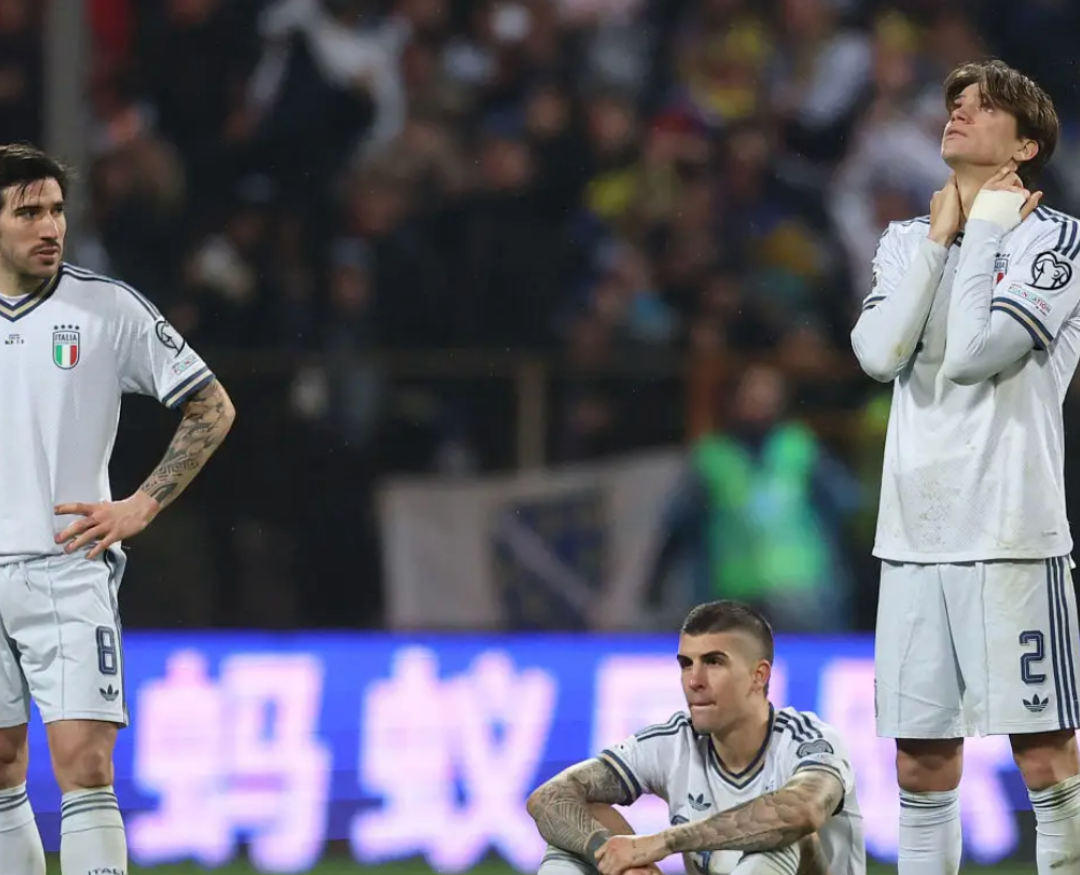
(Photo by Claudio Villa – FIGC/FIGC via Getty Images)
Italy missing the world cup is no longer an upset but instead a pattern.
Under former player Gennaro Gattuso, who took over as manager in June 2025, the Azzurri fell to Bosnia and Herzegovina on penalties after a 1-1 draw and failed to qualify for a third consecutive World Cup. Italy becomes the first former champions to miss three straight tournaments.
Gattuso, brought in to stabilize the national team after inconsistent qualification performances, now finds himself at the center of a result that defines this era of Italian football. He had emphasized mentality over tactics leading into the playoffs, urging his players to show some desperation to overcome the weight of past failures.
The match itself
For stretches, that approach worked. Italy started well — Moise Kean gave them a 1-0 lead early, and the midfield, led by Sandro Tonali, controlled the tempo. Tonali was the clearest positive across both matches in this international window, progressing the ball cleanly and providing composure in possession.
Then the match turned on a crucial decision. Alessandro Bastoni’s red card just before halftime after a reckless slide tackle altered the scene at hand.
Up 1-0, Italy went from controlling the match to defending it. From that moment on, Bosnia controlled possession and pushed the attack forward. They totaled 30 shots with 11 on target compared to Italy’s nine total shots with just three on target.
This is where Gattuso’s influence became particularly significant, immediately changing the tactic to a park-the-bus to maximize defense after losing Bastoni. Attacker Mateo Retegui was quickly subbed off for defender Federico Gatti.
His team showed fight, but once reduced to 10 men, Italy lacked the ability to control the match. The response was reactive and desperate, rather than disciplined. Bosnia dictated the pace, and Italy absorbed constant pressure for over an hour.
But Gianluigi Donnarumma helped kept the Azzurri alive. He delivered a phenomenal performance, with ten saves on eleven shots on target. Until the 79th minute, Italy looked like they could hold strong, even with 10 men.
The equalizer
Haris Tabaković equalized late, sending the match into extra time and pushing Italy toward a penalty shootout.
Then came the collapse. Pio Esposito completely missed the goal on Italy’s first penalty. Tonali converted, but following Bryan Cristante’s miss off the crossbar on Italy’s third shot, Bosnia clinically converted their fourth out of four penalties to punch their ticket to the World Cup — which they have not qualified for since 2014.
Gattuso took responsibility post-game, expressing pride in the players’ effort but acknowledging the pain of the result.
The larger issue at hand goes beyond one match:
2018: Sweden (0-1)
2022: North Macedonia (0-1)
2026: Bosnia (1-1) (1-4 pens)
Gattuso was brought in to reset the mentality of the group, to bring back the intensity and identity that defined Italy for decades. He was a part of that himself, being a key piece of the 2006 World Cup-winning squad alongside legends like Andrea Pirlo, Gianluigi Buffon, Francesco Totti and Fabio Cannavaro, a team built on control, defensive dominance and composure under pressure that carried Italy to its fourth World Cup title.
Across three failed qualification cycles, the pattern has remained the same: individual quality with encouraging moments, but no results or ability to maintain control.
This 2026 result raises questions about whether this identity Gattuso was brought in to restore can feasibly be restored. The Azzurri do still have pieces. Tonali is twenty-five years old and has shown he can dictate matches at this level. Donnarumma continues to show that he is one of the greatest goalkeepers of this generation. This contrast represents the gap, which feels wider now than ever.
This is not coincidence anymore, and Italy must make a drastic change if they want to restore their competitive identity.